Tuesday, November 25, 2014

Historic Pigments On Display, Colors of the Past (Harvard Art Museums)


A new exhibit at the Straus Center of the Harvard Art Museums, newly reopened November 2014 after a 6 year renovation, features examples of actual historic pigments. On display, patrons get to see the real shades of red, green, blue and more that were used to create painting, textiles, and other art of previous eras -- many in their original glass bottles.


Understanding how pigments may change over time (something painted red in 1850 may look yellow to our eyes today, affecting how we perceive and interpret the art), led to modern conservation efforts. The Straus Center today houses a cutting edge conservation laboratory.

"Through glass walls visitors can see scientific conservation in process, which goes back to [another Harvard art institution] the Fogg’s founding in 1927 and pioneer conservationist and director Edward Waldo Forbes. While collecting art around the world for the new museum, Forbes got intrigued by how paintings were made, and why some deteriorated. Gradually and then obsessively he amassed a collection of painting pigments, many of which are displayed in their original glass containers on a wall of the Straus Center." Says online Art site, Hyperallergic. Perhaps the site is aptly named, knowing many historic pigments contained poisons, and caused reactions up-to-and-including death.
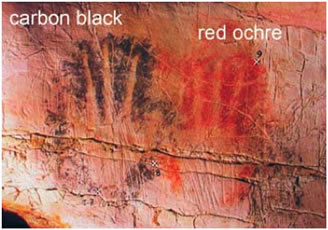

According to Wikipedia, "The earliest known pigments were natural minerals. Natural iron oxides give a range of colors and are found in many Paleolithic and Neolithic cave paintings. Two examples include Red Ochre... and Yellow Ochre (Fe2O3.H2O). Charcoal, or carbon black, has also been used as a black pigment since prehistoric times. Two of the first synthetic pigments were white lead and blue frit (Egyptian Blue)."


"The Industrial and Scientific Revolutions brought a huge expansion in the range of synthetic pigments, pigments that are manufactured or refined from naturally occurring materials, available both for manufacturing and artistic expression. Because of the expense of Lapis Lazuli, much effort went into finding a less costly blue pigment."

An of course, advances in pigment science affect more than just art we hang on our walls (or in galleries and museums). The pigments available to artists affect changing aesthetics of the times -- reflected in everything from decor to clothing and much more. They can also affect our way of life:

"Discoveries in color science created new industries and drove changes in fashion and taste. Organic chemistry delivered the final blow for the cochineal color industry. When chemists created inexpensive substitutes for carmine, an industry and a way of life went into steep decline."

Thursday, November 20, 2014

1800s: Green Wallpaper Responsible for Thousands of Deaths


Throughout the ages, people have suffered for what is fashionable.  In the 1800s, thousands of people died to to exposure to arsenic used in producing green wallpaper (not to mention green clothing, hats, shoes and much more).

"[Arsenic] was used in the production of green dyes, which were incorporated into everything from ribbons to playing cards. [T]he craze for deep green wallpaper...led to thousands of families meeting their deaths as a result of their taste in home furnishings. Not that they actually licked their walls: the dye was very unstable, so the slightest breeze could dislodge a puff of toxic dust." 

"Queen Victoria herself was so appalled by the homicidal tendencies of green wallpaper that she ordered every room in Buckingham Palace to be stripped of the stuff." Kathryn Hughes of The Guardian explains in a review of the new book by author James C. Wharton, The Arsenic Century.

It makes us very glad that arsenic is not used in the production of green dyes for home or textiles today!


Monday, November 17, 2014

Shop Small for Holiday Gifts @ An Etsy Trunk Show


Shop Small on November 29th, Small Business Saturday, by attending an Etsy Trunk Show near you -- and knock out your holiday gifts at the same time.

Another tip: If you have an American Express card visit the Small Business Saturday directory and website regularly - as AmEx usually offers cardholders a special discount or statement credit for shopping a participating small biz on the event day.


Saturday, November 15, 2014

Real J. Rohr Clients: Inspiration for a Dining & Living Room


This room was the color palette and "feeling" inspiration for a family living room/dining room for one of our current J. Rohr design clients.  We chose to go a little deeper with the main wall color in the clients room to add drama and color (deepening from the khaki used in this inspiration, to a more intense olive shade in a similar family).

To get a solid shot of yellow-gold in our clients' room, we also painted an entire accent wall in a vivid harvest color.


The grey-blue used in the room below will likely be a favorite accent color.


Additionally, the client is adding custom wainscoting and crown molding to the dining area.


Here's the project below, at our clients' home, midway through this week -- paint is up, and working on the wainscoting.  Next will be finishing the wainscoting.  We'll update you once the project is closer to completion -- please check back!


We were lucky enough to find this vintage piece at a local resale shop -- we can't wait to see it in the home.


Textured Wool Carpets - Luxe, Unique, Eco-Friendly


Looking for unique carpet options that are outside the norm?  We can recommend sore unique textured and sculpted options, in dozens of modern and classic styles. 

In fact, there are new blended styles that go beyond plush or twist, and offer a serious design statement.  From exotic (faux!) hide prints in cheetah or zebra, to geometrics, these carpet options really increase your style factor at home.


Besides looks, wool carpets have other benefits as well.

According to Stanton, a quality carpet manufacturer, fine quality, all-natural wool offers numerous advantages when used in flooring. It has been the standard in floor covering for centuries and represents all the qualities that synthetic fibers try to emulate:

  • BIODEGRADABLE Wool is a biodegradable natural fiber and one of the most environmentally forgiving flooring products.
  • RENEWABLE Wool is a renewable product and therefore has less impact on the environment.
  • SUSTAINABLE LIFE CYCLE Wool has a longer life cycle than other fibers resulting in a smaller environmental footprint.
  • NON ALLERGENIC Wool is a non-allergenic fiber and does not promote the growth of bacteria and dust mites, or give off harmful emissions.
  • STAIN-RESISTANT Wool cleans better and won’t soil quickly due to its natural soil resistance, making chemical stain protection treatments unnecessary.
  • AIR PURIFYING Wool fibers absorb and neutralize polluting gases such as formaldehyde, sulphur dioxide and nitrous oxides.